China's Manufacturing Revolution: How AI and Robotics Are Securing Global Dominance
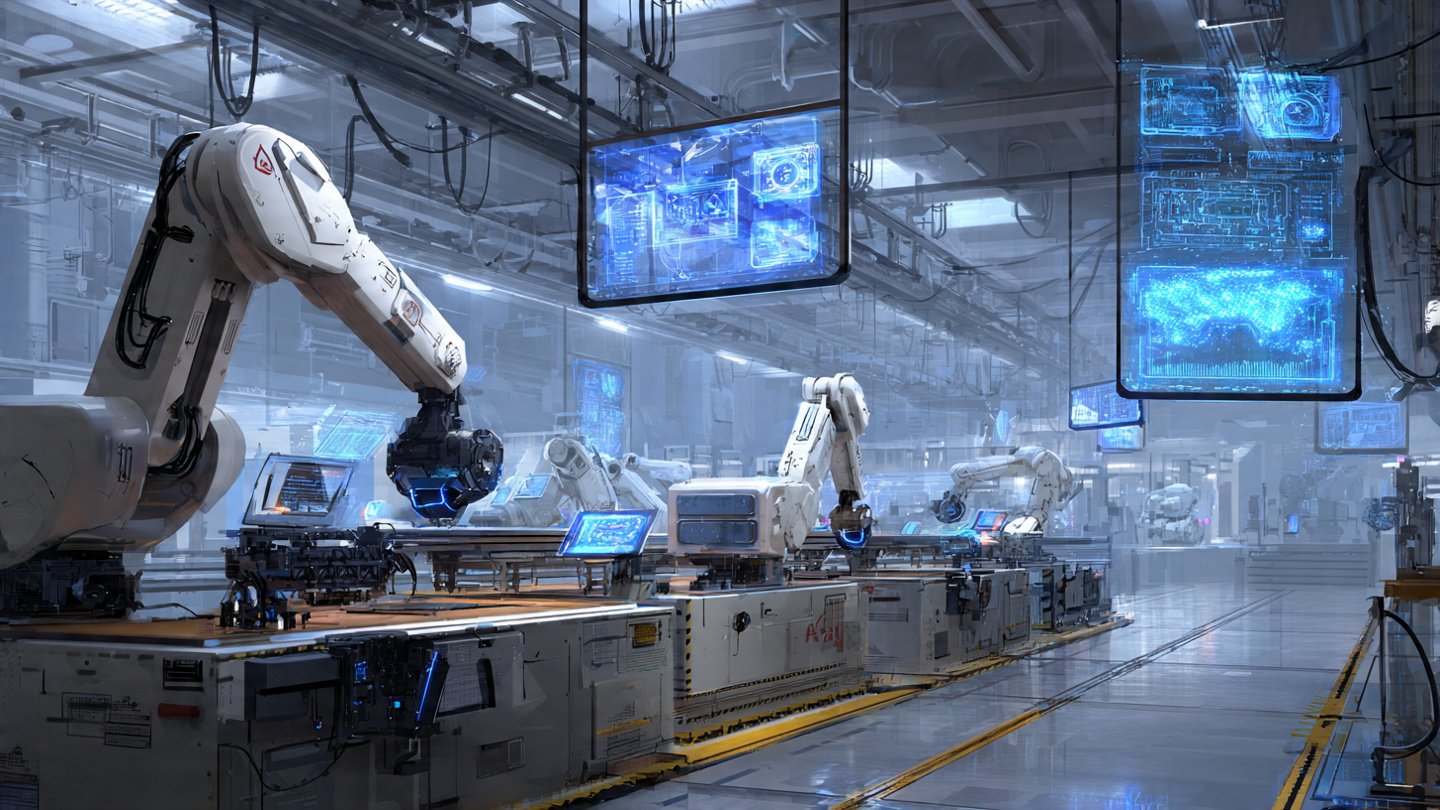
While Silicon Valley debates the future of artificial intelligence, China is quietly deploying it to solve an immediate challenge: maintaining its status as the world's factory floor. With rising labour costs, demographic shifts, and mounting international trade pressures, Chinese manufacturers are turning to AI and robotics not for philosophical breakthroughs, but for practical survival. The transformation is remarkable in both scale and speed. **Midea**, the global appliance giant, has created what executives call a "factory brain" at its Jingzhou plant. This AI system orchestrates virtual agents that communicate with robots and machinery, reducing processes that once took 15 minutes to just 30 seconds. This isn't isolated innovation. Across China, billions in government and private investment are flowing into what officials describe as "living organism" factories that think and adapt autonomously, moving far beyond traditional automation.The Numbers Behind China's Robot Army
By The Numbers
- 295,000 industrial robots installed in China last year, nearly nine times more than the US
- Over two million operational robots nationwide as of 2024, the world's highest concentration
- 45 of the World Economic Forum's 131 most productive factories are in mainland China, compared to just three in the US
- Manufacturing accounts for 25% of China's value-added GDP, significantly above the global average
- 83% of Chinese respondents view AI-powered products favourably, double the US rate
"Only by proactively embracing change can we remain invincible in this revolution," remarked Hu Wangming, chairman of a major Chinese steel group, capturing the national mood around AI adoption.
Dark Factories: Manufacturing Without Human Presence
The concept of "dark factories" represents the logical endpoint of China's automation drive. These facilities operate with such minimal human intervention that lighting can be dimmed or eliminated entirely. At **Baosteel**'s Shanghai plant, a handful of operators monitor dozens of screens while AI handles tasks that previously required human oversight every three minutes, now needing attention only every 30 minutes. This transformation extends beyond heavy industry. A clothing designer has slashed sample production time by over 70% using AI tools, while the massive Port of Tianjin deploys self-driving trucks and AI scheduling systems that compress 24-hour planning cycles into 10 minutes."We are the future," declares a Tianjin port executive, embodying the confidence driving China's technological leap forward.The port's **PortGPT** system, developed with **Huawei**, analyses video and images to potentially replace human safety officers, whilst more than 88% of large container equipment operates autonomously. This level of automation would face significant resistance in markets like the US, where labour agreements prohibit fully automated terminals until 2030.
Sector-by-Sector AI Integration
Manufacturing applications span industries with impressive precision gains. **Huawei** engineers working with **Conch Group**, a major cement producer, developed AI tools predicting clinker strength with over 85% accuracy compared to 70% manual rates. This improvement enables better raw material management and achieved a 1% reduction in coal consumption, saving nearly $300,000 annually per production line.| Industry | AI Application | Performance Improvement |
|---|---|---|
| Steel | Automated monitoring | Oversight reduced from every 3 minutes to 30 minutes |
| Textiles | Design optimisation | Sample production time cut by 70% |
| Cement | Quality prediction | Accuracy increased from 70% to 85% |
| Ports | Logistics planning | Planning time reduced from 24 hours to 10 minutes |
| Electronics | Assembly automation | Processes accelerated from 15 minutes to 30 seconds |
Global Implications and Competitive Response
China's manufacturing AI revolution directly challenges other nations' industrial strategies. The speed of deployment, coupled with supportive government policies, creates competitive advantages that rivals struggle to match. While the US attempts to limit China's access to advanced chips through export controls, Chinese companies are finding ways to maximise efficiency with available technology. The demographic dividend that powered China's initial economic rise is reversing, but AI offers a solution to labour shortages without unemployment spikes. Vice Minister Zhang Yunming of the Ministry of Industry and Information Technology has stated that embracing AI is "a necessary task and not an optional one" for maintaining economic growth. This transformation echoes across Asia, where countries are developing their own AI manufacturing strategies. The broader trend of humanoid robotics deployment shows how automation is reshaping production even for Western brands manufacturing in Asia. Companies like **Tesla** and **Apple** already benefit from China's automated manufacturing capabilities, creating complex dynamics where Western firms rely on Chinese AI-enhanced production whilst their governments seek to limit China's technological advancement.How do dark factories operate without human workers?
Dark factories use interconnected AI systems, sensors, and robots that communicate autonomously. These facilities can operate with lights dimmed or off because machines don't need illumination, though human oversight remains for complex problem-solving and maintenance tasks.
What challenges does China's aging population create for manufacturing?
China faces a projected 200 million population decline over 30 years, with younger workers increasingly avoiding factory jobs. This demographic shift creates labour shortages that AI and robotics are designed to address without causing unemployment spikes.
How does China's AI adoption differ from Western approaches?
Chinese companies focus on immediate productivity gains and practical applications rather than theoretical breakthroughs. The absence of independent labour unions and strong government support enables faster implementation compared to Western markets with stronger worker protections.
Can other countries replicate China's manufacturing AI success?
Replication requires significant infrastructure investment, supportive policies, and workforce adaptation. Countries like South Korea are attempting similar strategies with varying approaches and timelines for AI commercialisation.
What role do US chip export controls play in China's AI strategy?
Export controls limit access to cutting-edge processors, but Chinese companies are maximising efficiency with available technology. The restrictions have accelerated domestic chip development whilst not significantly slowing AI deployment in manufacturing applications.