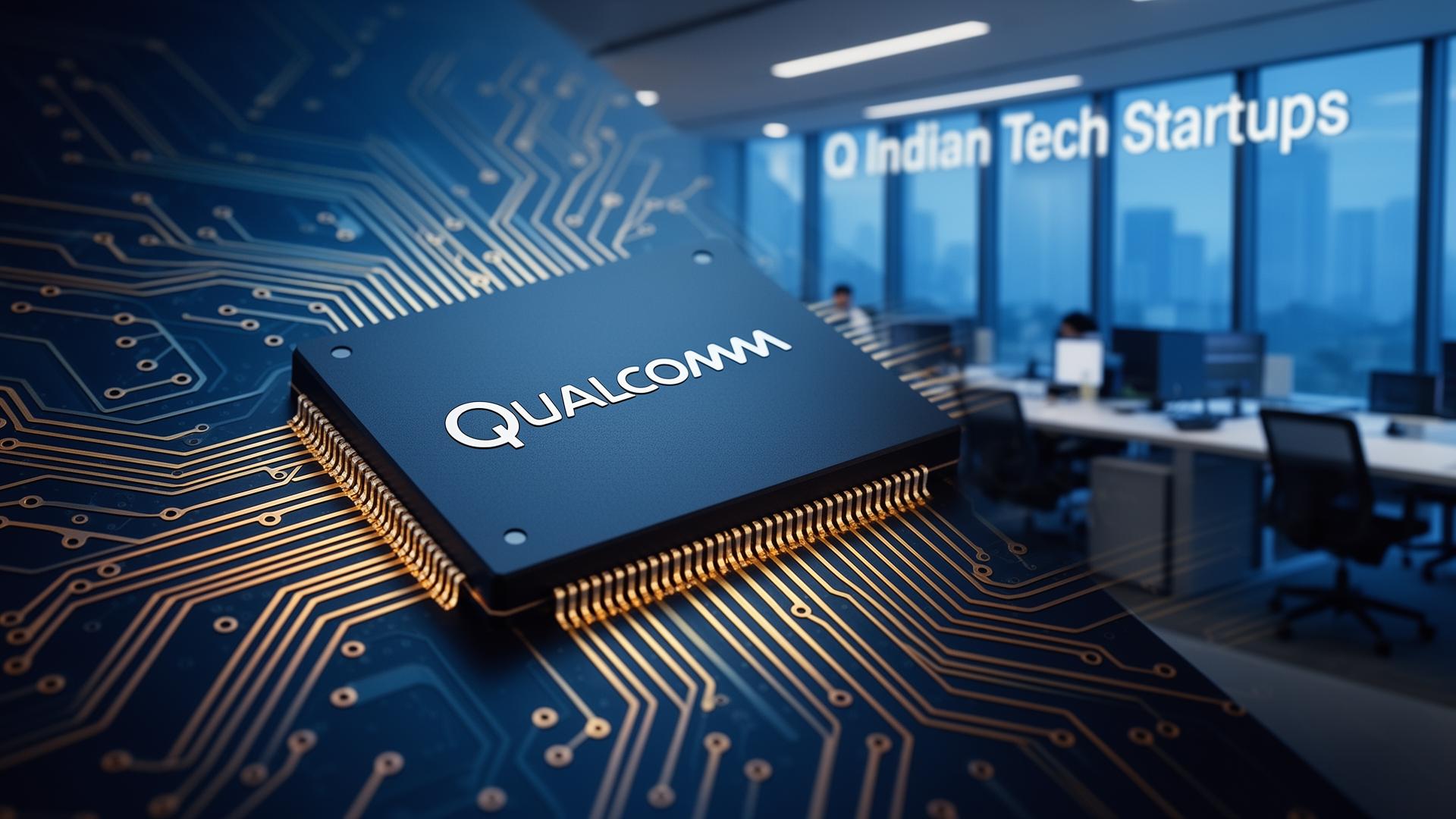
Qualcomm is putting $150 million behind a conviction that the next wave of AI will not live in the cloud. The chipmaker's new Strategic AI Venture Fund, announced by CEO Cristiano Amon at the India AI Impact Summit in New Delhi, targets Indian startups building intelligence directly into devices, vehicles, and industrial systems. It is the largest single AI venture commitment by a semiconductor company in India to date.
The fund arrives at a moment when India's AI startup ecosystem is maturing rapidly but remains heavily skewed towards software and cloud-based solutions. Qualcomm is betting that the country's next competitive edge lies at the edge.
What the Fund Will Back
Routed through Qualcomm Ventures, the fund will invest across all startup stages, from seed to growth, with a clear focus on four verticals: automotive AI, Internet of Things, robotics, and mobile technologies. The common thread is edge AI, where inference happens on-device rather than in a remote data centre.
This is not Qualcomm's first bet on India. The company has backed more than 40 Indian startups since 2007, including Jio, MapMyIndia, and drone manufacturer ideaForge. But the dedicated $150 million vehicle signals a step change in ambition and focus.
BY THE NUMBERS
- $150 million committed to the Strategic AI Venture Fund
- 40+ Indian startups backed by Qualcomm Ventures since 2007
- 4 verticals targeted: automotive, IoT, robotics, mobile AI
- $250 billion+ in total AI infrastructure pledges at the India AI Impact Summit
The Edge AI Thesis
Amon's announcement was as much about Qualcomm's product strategy as it was about Indian startups. The company's Snapdragon processors already power a significant share of the world's smartphones, and its push into automotive and industrial chips depends on a thriving ecosystem of developers building on-device AI applications.
"AI is entering a new phase where intelligence is built directly into devices and systems people depend on every day, from smartphones and PCs to cars, industrial machines, robots, and more. This shift will reshape entire industries, and India's startup ecosystem has a critical role to play." - Cristiano Amon, CEO, Qualcomm
India offers Qualcomm something that few other markets can: a massive domestic market for edge devices combined with a deep engineering talent pool capable of building the software stack those devices require. The country ships over 150 million smartphones annually, most running Qualcomm silicon, and its automotive market is electrifying rapidly.
Why Vernacular AI Matters
One under-discussed dimension of the fund is its potential to accelerate vernacular AI, applications that work natively in India's 22 official languages. On-device inference is critical for vernacular applications because it eliminates latency and works in low-connectivity environments where many Indian users live.
"India's edge AI opportunity is unique because the use cases here require multilingual, low-power solutions that work offline. That is not a limitation, it is a design constraint that will produce globally exportable technology." - Aloknath De, former CTO, Samsung India, and AI ecosystem adviser

How This Compares to Other Chipmaker Bets on India
Qualcomm's $150 million fund enters a competitive landscape. Other semiconductor companies have made significant commitments to India's AI ecosystem in recent months:
- NVIDIA partnered with Reliance Industries to build AI infrastructure and announced plans for an AI research centre in Bengaluru, though its India investments focus more on compute infrastructure than venture funding.
- AMD expanded its India design centre to over 6,500 engineers and launched an AI developer programme, but has not established a dedicated venture fund.
- Intel maintains its largest non-US design centre in Bengaluru with 14,000 employees, but its India AI investments have centred on R&D rather than startup funding.
- Samsung operates its largest R&D centre outside South Korea in India, focusing on on-device AI for its Galaxy ecosystem.
Qualcomm's approach is distinctive because it directly funds the startup ecosystem rather than building internal R&D capacity. The bet is that external innovation, properly funded, will produce better edge AI applications than in-house development alone.
The Asia-Pacific Picture
India's position in the global AI hardware stack is evolving. The country is not a chip fabricator, that role belongs to Taiwan and increasingly to the United States and Japan through reshoring initiatives. But India is emerging as the preferred destination for chip design, AI application development, and large-scale deployment testing.
The India AI Impact Summit, where Amon made his announcement, catalysed over $200 billion in AI-related investment commitments. Google's Sundar Pichai announced a $15 billion AI hub in Visakhapatnam. The Indian government launched BharatGen Param2, a 17-billion parameter multilingual model. And 88 countries adopted the New Delhi Declaration on responsible AI development.
For Qualcomm, India is both a market and a proving ground. If Indian startups can build edge AI applications that work across languages, connectivity levels, and price points, those solutions become instantly exportable to Southeast Asia, Africa, and Latin America.
What Comes Next
Fund DeploymentStructure announced, pipeline being builtFirst 8-10 investments across seed to Series B Edge AI EcosystemSnapdragon developer tools availableDedicated India edge AI accelerator programme Vernacular AIEarly-stage startups, fragmented market3-5 funded startups with multilingual on-device models Automotive AIIndia EV market growing, ADAS adoption lowQualcomm-backed startups piloting ADAS solutions Deep Tech AllianceQualcomm joined India Deep Tech Investment AllianceCo-investment deals with Indian and US LPs
Frequently Asked Questions
What is Qualcomm's Strategic AI Venture Fund?
It is a $150 million fund announced in February 2026, operated through Qualcomm Ventures, targeting Indian startups building AI applications for devices, vehicles, and industrial systems. The fund backs startups at all stages with a focus on edge AI, where processing happens on-device rather than in the cloud.
Which Indian startups has Qualcomm previously invested in?
Qualcomm Ventures has backed more than 40 Indian companies since 2007, including Jio (telecommunications), MapMyIndia (mapping and navigation), and ideaForge (drone technology). The new fund significantly expands the scale and AI-specific focus of these investments.
Why is edge AI particularly important for India?
India has over 800 million internet users but connectivity remains uneven, particularly in rural areas. Edge AI processes data on the device itself, eliminating the need for constant cloud connectivity. This makes AI applications more accessible across India's diverse infrastructure landscape and enables vernacular language support with lower latency.
THE AIINASIA VIEW
We think the real story here is not the $150 million. It is the thesis behind it. Qualcomm is arguing that India's AI advantage will come from the edge, not the cloud, and that the constraints of the Indian market (multiple languages, patchy connectivity, price sensitivity) are actually design advantages that produce globally competitive products. If that thesis proves right, it inverts the conventional wisdom that AI innovation flows from rich markets to developing ones. India would become the exporter, not the importer, of applied AI. We have not seen a chipmaker make that bet this explicitly before.
The semiconductor industry loves to announce funds. The question that separates signal from noise is deployment speed: will Qualcomm Ventures move fast enough to back the best Indian edge AI startups before Google, Microsoft, and domestic players like Reliance snap them up? If you were building an edge AI startup in Bengaluru right now, would Qualcomm's fund be your first call or your backup plan? Drop your take in the comments below.
YOUR TAKE
We cover the story. You tell us what it means on the ground.
What did you think?
Share your thoughts
Be the first to share your perspective on this story
This is a developing story
We're tracking this across Asia-Pacific and may update with new developments, follow-ups and regional context.