
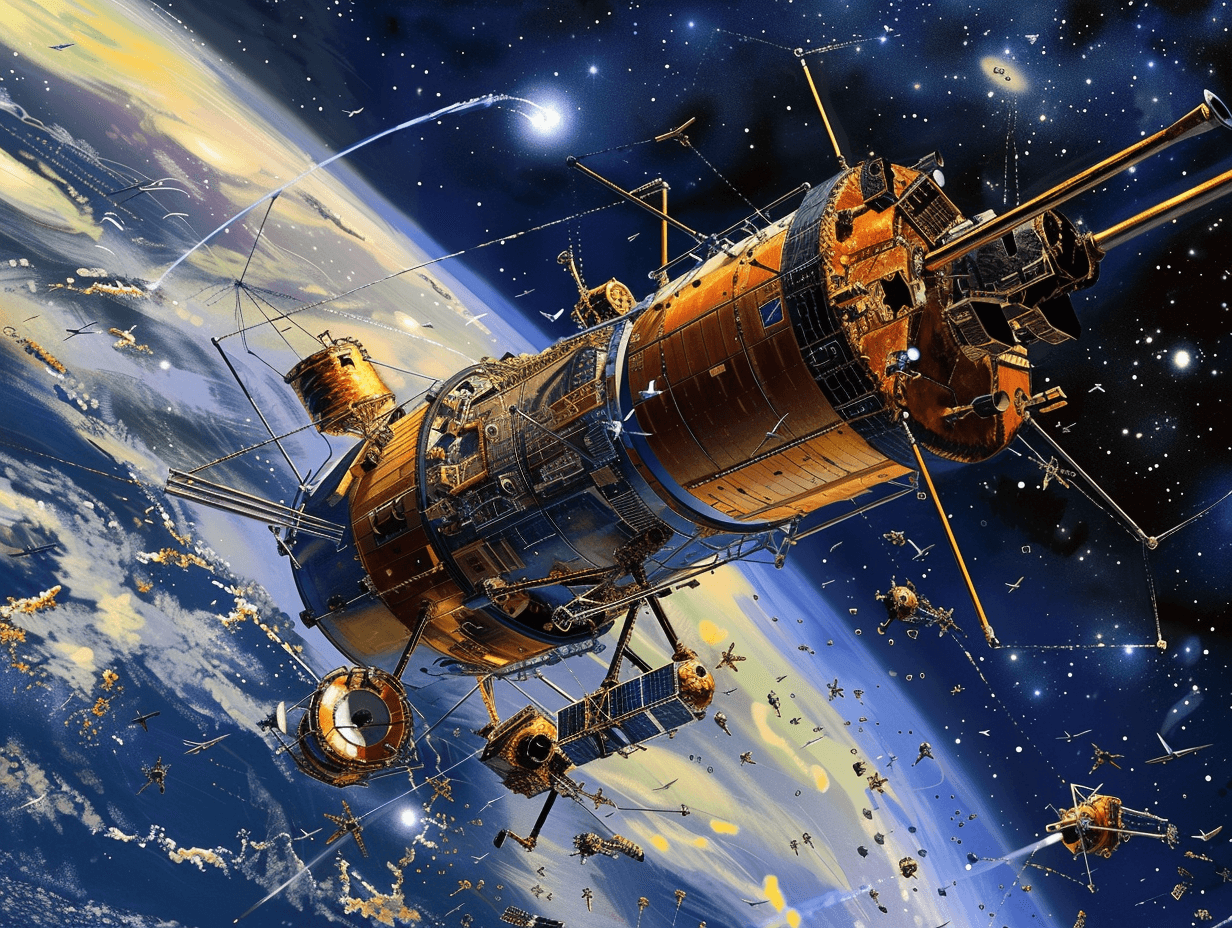
AI in space faces challenges like power consumption, radiation, and software modifications.,Onboard AI offers benefits such as real-time data processing, autonomous decision-making, and improved spacecraft performance.,Companies are developing creative solutions, like space-qualified chips and hardware protection, to bring AI to space.
The Challenge of AI in Space
Artificial intelligence (AI) and machine learning (ML) have the potential to revolutionise space applications. However, integrating AI onboard satellites is a complex task. Sylvester Kaczmarek, Chief Technology Officer at OrbiSky Systems, a London-based startup focused on AI edge operations, explains, "Running AI in space is like running a marathon on the moon — impressive if achieved, but limited by the environment."
Power consumption is a significant challenge. Advanced processors used for AI are power-hungry, requiring large solar panels and extra batteries. Additionally, "radiation in space can fry electronics," says Kaczmarek. Power management is another hurdle, as AI devices demand high currents at low voltages, which is new to the space industry.
Software modifications are also necessary. Kaczmarek states, "Space missions demand AI techniques that can crunch data with limited power and memory." Ralph Grundler, Aitech Systems' Director of Space Business Development, emphasises the challenge: "Space loves AI, but AI doesn’t seem to love space." For more on the broader implications of AI's advancements, read about AI's Secret Revolution: Trends You Can't Miss.
The Benefits of Onboard AI
Despite the challenges, the potential benefits of onboard AI are too significant to ignore. AI can process data in real-time, enabling satellites to transmit the most important datasets first and compress the remaining data for onboard storage. This capability is crucial as the latest remote-sensing satellites gather far more data than they can quickly downlink.
Onboard AI can also improve spacecraft performance. Andrew Haslehurst, Chief Technology Officer at Surrey Satellite Technology, suggests that if a satellite experiences a latchup, a type of short circuit, the onboard AI could identify the problem and remedy it through power cycling or other means. This echoes discussions around AI with Empathy for Humans in its ability to diagnose and respond to complex situations.
Creative Solutions for AI in Space
To help satellites take advantage of AI, companies are developing innovative solutions. Mercury Systems, for example, co-developed a space-qualified processing board for field programmable gate arrays with Ball Aerospace. OrbiSky is creating new components for AI processing on spacecraft and drones, referred to as "high-performance, secure AI brains for machines" by Kaczmarek. This push for specialized hardware is also seen in efforts like Nvidia Jetson AGX Thor sets a new pace for robotics and physical AI.
Singapore-based Zero Error Systems produces hardware and software for space-based electronics. Their Latchup Detection and Protection system monitors commercial-off-the-shelf (COTS) integrated circuits and resets the power when a latchup is detected. For further reading on the challenges and solutions in space electronics, a detailed report from the European Space Agency (ESA) on radiation effects in space electronics provides valuable insights.
Mission-Dependent Approaches
The best approach to integrating AI onboard satellites depends on the mission. Satellites in low-Earth orbit could utilise the latest commercial-off-the-shelf electronics. However, satellites in geostationary or cislunar orbit may require space-qualified parts, shielding, or other creative solutions to mitigate radiation's impact. This adaptive approach is vital, similar to how different regions in North Asia employ diverse models of structured governance for AI.
Comment and Share:
What do you think about the future of AI in space? How can we overcome the challenges to unleash AI's full potential in space applications? Share your thoughts in the comments below and don't forget to Subscribe to our newsletter for updates on AI and AGI developments.










Latest Comments (3)
the bit about "limited power and memory" for AI in space. sounds exactly like what we deal with for edge applications here in malaysia. same constraints, different environment.
The power consumption challenges for AI in space really resonate with what we see in healthcare. When we're deploying AI models for diagnostics or patient monitoring, the energy footprint isn't just about cost, it's about reliability and access, especially in remote or underserved areas. We wouldn't be dealing with radiation frying chips, thankfully, but the need for "AI techniques that can crunch data with limited power and memory" is a direct parallel. Our systems have to be robust enough to run locally on devices, minimizing latency and ensuring patient data stays secure without constant cloud reliance. It's that trade-off between powerful processing and environmental constraints, whether it's a satellite or a hospital, that really defines the engineering problem.
this discussion on power consumption and radiation resilience, while crucial, often overlooks the broader question of equitable access to these advancements. if only a few nations can overcome these technical hurdles, does it not exacerbate existing spatial and digital divides, particularly for countries in the Global South hoping to leverage satellite data for sustainable development?
Leave a Comment