
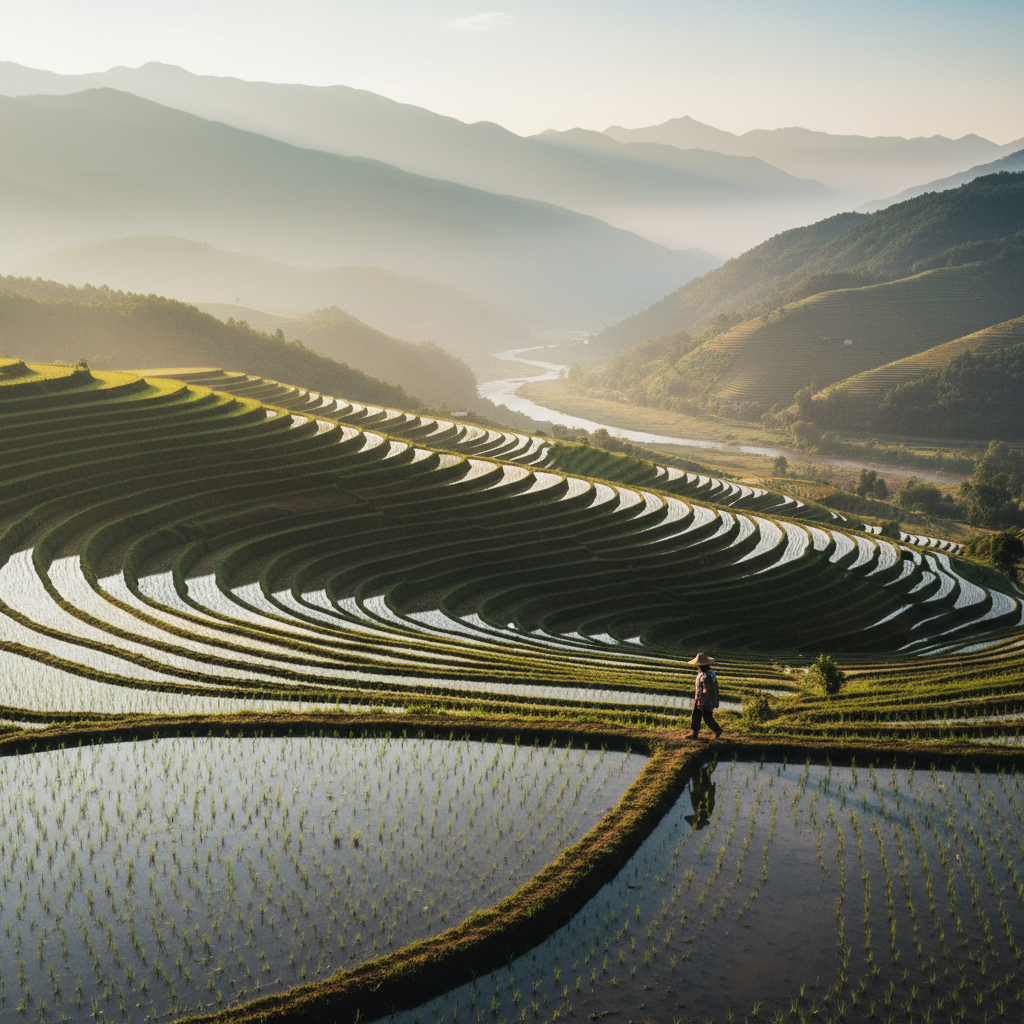
Trained in California, Deployed in Karnataka
The AI models that Google, Meta, and Microsoft have built for agriculture share a common problem. They were trained overwhelmingly on Western data, and when deployed in the fields of India, Kenya, or Southeast Asia, they routinely misidentify crops, miss trees, and fail to account for the realities of smallholder farming.
Agriculture provides livelihoods for over two billion people in low and middle-income countries. The digital farming market is worth approximately $30 billion in 2025 and is forecast to reach $84 billion by 2034. But the technology powering that growth is still designed primarily for the large-scale, data-rich farms of North America and Europe.
When the Model Cannot See the Forest
In Maharashtra, India, the non-profit Farmers for Forests tried using Meta's open-source Detectron2 model to map tree cover on agricultural land. The result was not encouraging. The model missed more than half the trees because it had been trained on North American forests. The team eventually had to manually annotate 55,000 trees across 80 land parcels to build a dataset that actually reflected local conditions.
"You cannot simply parachute Western AI into the Global South and expect it to work." - Arti Dhar, Co-founder and Director, Farmers for Forests
The problem extends beyond tree detection. In western Kenya, Catherine Nakalembe, an assistant professor at the University of Maryland and Africa Programme Director for NASA Harvest, found that satellite imagery trained on Western crop patterns could not reliably identify local crops. Her team resorted to collecting over five million crop images using GoPro cameras mounted on volunteer helmets to build ground-truth data from scratch.
By The Numbers
- 2 billion+: People in low and middle-income countries whose livelihoods depend on agriculture
- $492.71 million: Asia-Pacific AI in agriculture market size in 2024, growing at 25.5% CAGR to 2031
- 50%+: Trees missed by Meta's Detectron2 model when applied to Indian farmland
- 5 million: Crop images collected by hand in Kenya to compensate for inadequate Western training data
- $84 billion: Projected global digital farming market by 2034
The Connectivity and Literacy Gap
Even when AI models work technically, they often fail practically. Most agricultural AI tools assume reliable internet connectivity, smartphone literacy, and decision-making authority that many smallholder farmers in Asia simply do not have. Digital Green, an organisation reaching over one million farmers across South Asia and Africa, has built its FarmerChat platform in 16 languages specifically to address this gap. The system has answered over eight million farmer questions to date.
"If AI assumes literacy, connectivity, or decision authority, it only benefits better resourced farmers first." - Rikin Gandhi, Co-founder and CEO, Digital Green
In Brazil's Para state, a simpler approach has worked: WhatsApp voice alerts for fishers and oyster farmers who need timely weather and tide information. No app download required, no literacy barrier, no expensive hardware. The lesson is that effective agricultural AI in developing economies often looks nothing like the polished platforms coming out of Silicon Valley.
Local Data, Local Solutions
The organisations making real progress are the ones building from local data upward rather than adapting Western models downward. India's government hosted the AI Impact Summit 2026 in New Delhi in February, convening researchers and policymakers to discuss deploying AI models trained specifically on Indian soil types, climate zones, and crop varieties.
- India is developing small, purpose-built AI models deployable in low-connectivity rural areas through mobile phones and existing farm equipment
- South Korea plans to launch an agricultural satellite in July 2026 and establish a dedicated agricultural data centre for AI-driven supply and demand forecasting
- Digital Green's FarmerChat trains on vernacular agricultural knowledge in 16 languages, reaching farmers who speak no English
- NASA Harvest is building open crop identification datasets for East Africa and South Asia using ground-level photography rather than satellite-only data
| Approach | Example | Data Source | Who Benefits |
|---|---|---|---|
| Western model, no adaptation | Meta Detectron2 in India | North American forests | Largely ineffective for local conditions |
| Western model with local retraining | NASA Harvest in Kenya | 5 million local crop images | Researchers and extension workers |
| Purpose-built local model | FarmerChat (Digital Green) | 16-language vernacular farming knowledge | 1 million+ smallholder farmers |
| Low-tech AI delivery | WhatsApp alerts (Brazil) | Government weather/tide data | Fishers and coastal farmers |
The global AI in agriculture market was valued at $2.6 billion in 2025 and is expected to reach $13.0 billion by 2034. The question is how much of that growth will actually reach the two billion people who need it most, or whether it will remain concentrated in the wealthy, data-rich farming economies where these models already work well.
What Needs to Change
The Rest of World investigation into AI agriculture failures identified a structural problem: the incentives for big tech companies do not align with the needs of smallholder farmers. Building a crop identification model for Iowa is commercially rewarding. Building one for Odisha is not, at least not within the quarterly earnings framework that drives Silicon Valley investment decisions.
About 28% of the global population, roughly 2.3 billion people, face moderate to severe food insecurity. AI has genuine potential to help, but only if the models are trained on data that reflects the places where food insecurity actually exists.
Why do Western AI models fail on Asian farmland?
Most agricultural AI models are trained on data from large-scale North American and European farms. Asian and African farmland features different crop varieties, soil types, tree species, and farming practices that these models have never seen. Without local training data, the models cannot accurately identify or classify what they are looking at.
What is FarmerChat and how does it work?
FarmerChat is a multilingual AI platform built by Digital Green that answers agricultural questions in 16 languages. It has been trained on vernacular farming knowledge specific to South Asia and Africa, and has answered over eight million questions from more than one million farmers. It works on basic smartphones and does not require high-speed internet.
Is anyone building AI specifically for Asian agriculture?
Yes. India is developing lightweight AI models trained on local soil types, climate zones, and crop varieties that can run on mobile phones in low-connectivity areas. South Korea plans to launch an agricultural satellite in July 2026 for AI-driven crop monitoring. Several regional organisations are building open datasets for local crop identification.
The richest farms in the world get the best AI. The poorest farms get a model that cannot tell rice from wheat. Is that a market failure, a policy failure, or both? Drop your take in the comments below.
YOUR TAKE
We cover the story. You tell us what it means on the ground.
What did you think?
Share your thoughts
Be the first to share your perspective on this story
This is a developing story
We're tracking this across Asia-Pacific and may update with new developments, follow-ups and regional context.