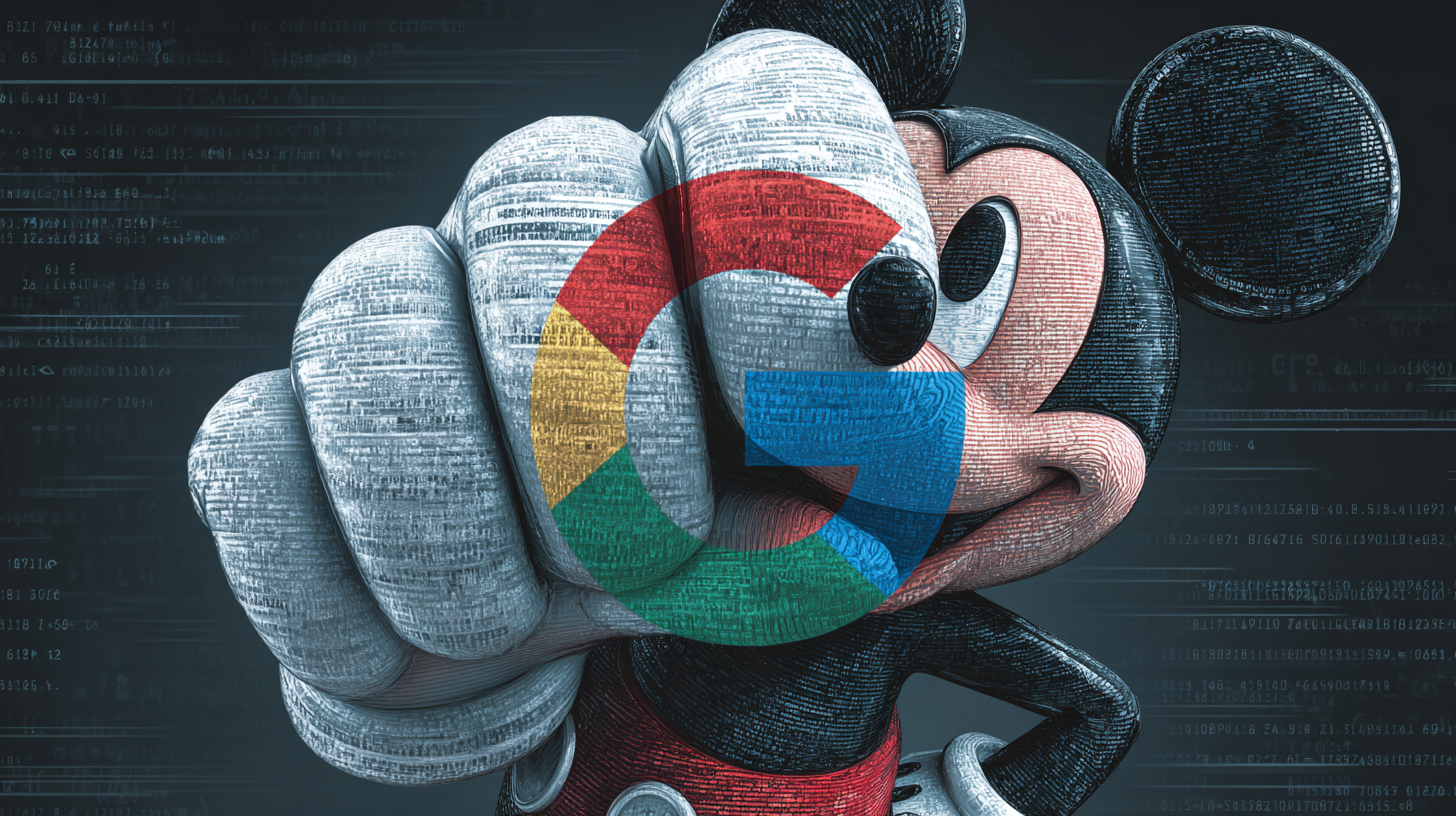
Disney is taking a two-pronged approach to artificial intelligence, simultaneously battling Google over alleged copyright infringement whilst forging a significant partnership with OpenAI. The entertainment giant recently issued a cease-and-desist letter to Google, accusing its AI models of "massive scale" infringement on Disney's intellectual property. This comes shortly after Disney announced a substantial $1 billion deal with OpenAI, allowing the AI firm to utilise Disney's extensive character catalogue for its video generation tools.
Google Accused of "Free Riding" on IP
Disney's letter to Google, sent last Wednesday, contends that Google's AI services are "designed to free ride off Disney's intellectual property." It claims Google has refused to implement readily available technological measures to prevent copyright infringement, measures that competitors reportedly use. Instead, Disney alleges, Google continues to "directly exploit Disney's copyrights for commercial gain."
The core of Disney's complaint, consistent with previous actions against other AI companies like Midjourney, centres on the ability of Google's AI models, including the latest Gemini 3 and its integrated NanoBanana Pro AI image model, to generate content overly similar to copyrighted characters. This echoes broader concerns within the creative industries regarding the rapid advancement of generative AI. For instance, creating AI-generated images that closely resemble established characters has become a contentious issue.
As the parent company of YouTube, Google is further accused of "flooding the market with infringing works" and profiting from this exploitation. Disney states it had raised these concerns with Google months ago, but with no resolution, the cease-and-desist letter became necessary. Google, for its part, acknowledges a "longstanding and mutually beneficial relationship" with Disney and asserts it uses open web data to build its AI, while also having copyright controls in place for its services.
A Billion-Dollar Alliance with OpenAI
In stark contrast to its legal challenge against Google, Disney has committed to a significant collaboration with OpenAI. The $1 billion agreement grants OpenAI clearance to use over 200 iconic Disney characters, encompassing franchises like Marvel, Pixar, and Star Wars, within its AI image and Sora video generation tools.
This strategic move designates Disney as a "major customer" of OpenAI, bringing ChatGPT to Disney employees and introducing select Sora AI videos to the Disney+ platform. This partnership highlights a burgeoning trend where intellectual property holders are exploring licensing opportunities with AI developers, rather than solely pursuing legal action. Such collaborations could help define the future of human-AI skill fusion in creative industries.
The Broader IP Landscape
Disney's actions underscore the ongoing tension between technological innovation in AI and the protection of intellectual property. The ability of generative AI to produce highly realistic images and videos has intensified these debates, forcing major IP owners to reassess their strategies. Other companies, such as Toku, are also navigating the complexities of emerging technologies and their market implications, as seen with Toku filing its IPO prospectus with MAS.
The challenge for companies like Disney is to balance the need to protect their valuable intellectual property with the potential for new revenue streams and creative applications that AI offers," notes a recent legal analysis.
This dual strategy by Disney – litigating against perceived infringers while partnering with others – reflects the complex and evolving landscape of AI and copyright. It illustrates that while some AI applications may be seen as "bottomless pits of plagiarism" a robust licensing framework can facilitate collaboration and innovation, a topic frequently discussed in the context of AI governance. The US Copyright Office has also issued guidance on copyrighting AI-generated works, outlining its stance on the matter here.
YOUR TAKE
We cover the story. You tell us what it means on the ground.
What did you think?
Share your thoughts
Be the first to share your perspective on this story
This is a developing story
We're tracking this across Asia-Pacific and may update with new developments, follow-ups and regional context.