
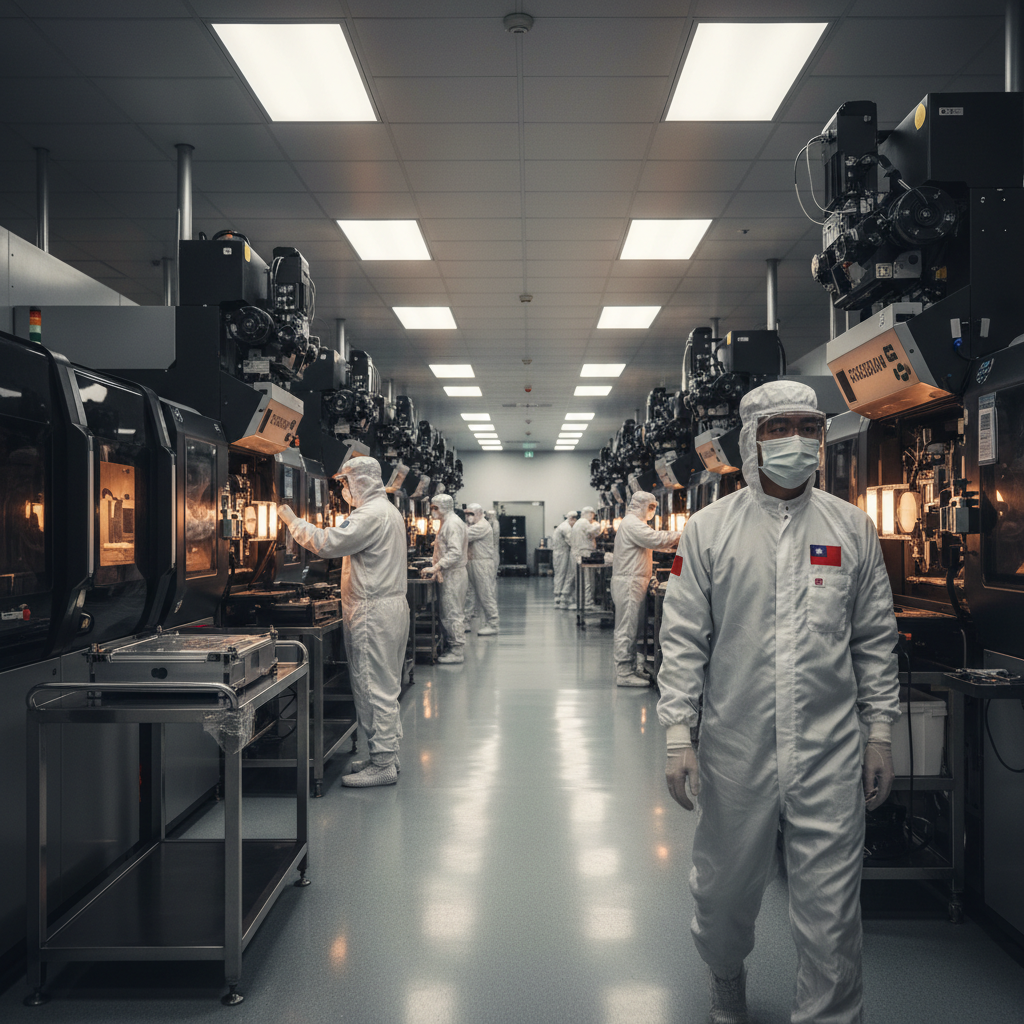
Jensen Huang's Warning Lands at the Worst Possible Time for Asia's Chipmakers
Nvidia CEO Jensen Huang has issued one of his starkest public warnings about the escalating technology conflict between Washington and Beijing, and the reverberations are being felt most acutely across Asia's chip-making heartlands. Speaking at a major industry event in early 2025, Huang cautioned that tightening US export controls on advanced semiconductors risk fragmenting the global supply chain in ways that could take decades to untangle.
His remarks arrive at a moment when governments across East and Southeast Asia are scrambling to secure their positions in a semiconductor landscape that is shifting beneath their feet. From Taipei to Tokyo, Seoul to Singapore, the question is no longer whether the US-China tech war will affect the region. It is how profoundly it will reshape it.
By The Numbers
- $52 billion allocated under the US CHIPS Act to reshore semiconductor manufacturing
- $143 billion pledged by China for domestic chip development through 2030
- Over 80% of the world's most advanced chips still manufactured in Taiwan
- 40% estimated revenue drop for Nvidia in China following the latest export restrictions
- $230 billion projected global semiconductor market growth by 2030
What Huang Actually Said and Why It Matters
Huang's warning was not merely about quarterly earnings or product roadmaps. He argued that restricting China's access to cutting-edge AI chips would accelerate Beijing's efforts to build entirely self-sufficient alternatives. In his view, aggressive export controls risk creating a formidable competitor rather than containing one.
"Every chip we don't sell to China is a chip they will eventually learn to make themselves. The question is whether we want to fund their independence." , Jensen Huang, CEO, Nvidia
This assessment has resonated deeply with industry leaders across Asia, many of whom depend on Chinese demand as a critical pillar of their revenue. Taiwan's TSMC, South Korea's Samsung, and Japan's Tokyo Electron all derive significant portions of their income from mainland Chinese customers. A sustained decoupling would force painful recalibrations across the board.
It is worth noting that Huang himself was born in Taiwan and has long maintained close ties to the region. His perspective carries weight not just as a business leader but as someone with a genuine stake in how this rivalry resolves. For a deeper read on the escalating rivalry, see our coverage of Huang's broader position on the US-China tech conflict and what it signals for the decade ahead.
Taiwan Sits at the Eye of the Storm
No territory has more at stake in the US-China tech war than Taiwan. TSMC produces roughly 90% of the world's most advanced semiconductors, making the island indispensable to both American and Chinese technology ambitions. The geopolitical pressure on Taipei has intensified as Washington pushes for more chip fabrication on American soil while Beijing continues its military posturing across the Taiwan Strait.
TSMC has responded by committing over $65 billion to new fabrication plants in Arizona. Industry analysts caution, however, that replicating Taiwan's manufacturing ecosystem elsewhere will take years and cost considerably more than originally projected. The talent pool that makes TSMC's operations possible remains overwhelmingly concentrated on the island, and there is no quick fix for that.
TSMC's Arizona Expansion vs. Taiwan Operations
| Factor | Taiwan (Current) | Arizona (Planned) |
|---|---|---|
| Process node capability | 2nm and beyond | 3nm (initial phases) |
| Investment committed | Decades of infrastructure | $65 billion+ |
| Workforce availability | Deep, established talent pool | Under development |
| Geopolitical risk | High (cross-strait tensions) | Lower |
South Korea and Japan Navigate Competing Pressures
South Korea finds itself caught between its security alliance with Washington and its deep economic ties to Beijing. Samsung and SK Hynix together control roughly 70% of the global memory chip market, and China remains one of their largest customers. The latest round of US restrictions has forced both companies to seek waivers and exemptions, a process that introduces uncertainty into long-term investment planning.
"Asian chipmakers are being asked to choose sides in a conflict where neutrality has historically been their greatest strategic advantage." , Industry analysis, AIinASIA
Japan's semiconductor revival strategy, anchored by the government-backed Rapidus consortium, aims to produce 2-nanometre chips by 2027. Tokyo has tightened its own export controls on chipmaking equipment to China, broadly aligning with Washington's approach. Japanese equipment makers such as Tokyo Electron and Screen Holdings have, however, expressed concern about the long-term impact on their order books. Alignment with US policy has a real commercial cost.
China's own response to this pressure is worth tracking closely. Beijing has committed enormous capital to building domestic capability, and the results are beginning to show. For a detailed look at how China is structuring its technological ambitions, our analysis of China's AI and technology five-year plan provides essential context.
The Asia-Pacific Picture
Southeast Asia is emerging as a quiet beneficiary of supply chain diversification. Malaysia already accounts for roughly 13% of global semiconductor packaging and testing, and new investments from Intel, Infineon, and GlobalFoundries are expanding that footprint further. Vietnam and Thailand have also attracted fresh semiconductor-related investment as companies seek to reduce concentration risk.
Singapore, with its established research infrastructure and stable regulatory environment, continues to serve as a regional hub for chip design and advanced manufacturing coordination. The city-state's Economic Development Board has been proactive in courting semiconductor firms displaced by geopolitical uncertainty, and there are signs that strategy is paying off.
- Malaysia: 13% share of global semiconductor packaging and testing; Intel, Infineon, and GlobalFoundries expanding
- Vietnam and Thailand: Attracting diversification investment from companies reducing Taiwan and China exposure
- Singapore: Established hub for chip design; EDB actively recruiting displaced firms
- India: Offering subsidies to attract fabrication plants; early-stage ambitions but growing momentum
- Australia and New Zealand: Reassessing supply chain dependencies without being major producers themselves
Industry bodies across APAC are calling for multilateral frameworks that would provide greater predictability for investment decisions. Progress has been slow, however, against the backdrop of escalating bilateral tensions between Washington and Beijing. The absence of a coherent regional voice on semiconductor policy remains a structural weakness for Asia-Pacific as a whole.
The energy demands of expanding semiconductor manufacturing are also worth noting. Chipmaking is extraordinarily power-intensive, and Asia's grid infrastructure is under pressure. Innovative solutions are emerging, including those covered in our feature on floating data centres addressing the region's energy crisis.
What the Semiconductor Fragmentation Means Long-Term
Huang's warning underscores a reality that many in the industry have been reluctant to confront publicly. The era of a truly integrated global semiconductor supply chain may be drawing to a close. The trend towards regional blocs, each with its own standards and supply networks, would represent a seismic shift from the model that drove decades of innovation and cost reduction.
For Asia's chip industry, the stakes could scarcely be higher. The region's dominance in semiconductor manufacturing has been built on decades of investment, talent development, and cross-border collaboration. Whether that dominance survives the current geopolitical turbulence will depend on how adeptly governments and corporations navigate the increasingly narrow space between Washington and Beijing.
The downstream effects on Asia's broader technology ecosystem are equally significant. AI development, cloud infrastructure, consumer electronics, and defence systems all depend on a reliable supply of advanced chips. Businesses across the region would do well to understand how smaller technology players are adapting to supply chain volatility and what strategies are proving most resilient.
Frequently Asked Questions
What exactly did Jensen Huang warn about regarding the US-China tech war?
Huang cautioned that US export controls on advanced chips to China could backfire by accelerating China's push to develop its own semiconductor capabilities. His argument is that restrictions may ultimately produce a stronger competitor rather than constraining one, particularly in AI chip development.
How does the US-China tech war affect Asian chipmakers specifically?
Asian semiconductor companies, particularly in Taiwan, South Korea, and Japan, face reduced access to one of their largest markets while simultaneously being pressured to align with US restrictions. This creates revenue uncertainty, complicates long-term investment planning, and forces difficult choices between economic relationships and security alliances.
Which Asia-Pacific countries stand to benefit from semiconductor supply chain diversification?
Malaysia, Vietnam, Thailand, and Singapore are attracting increased semiconductor investment as companies diversify away from concentrated manufacturing in Taiwan and China. India is also positioning itself as a potential fabrication destination, backed by government subsidies, though its ambitions remain at an earlier stage of development.
Given the enormous stakes for every technology-dependent industry in the region, what is your government or company actually doing to prepare for a fragmented semiconductor world? Drop your take in the comments below.
YOUR TAKE
We cover the story. You tell us what it means on the ground.
What did you think?
Share your thoughts
Be the first to share your perspective on this story
This is a developing story
We're tracking this across Asia-Pacific and may update with new developments, follow-ups and regional context.