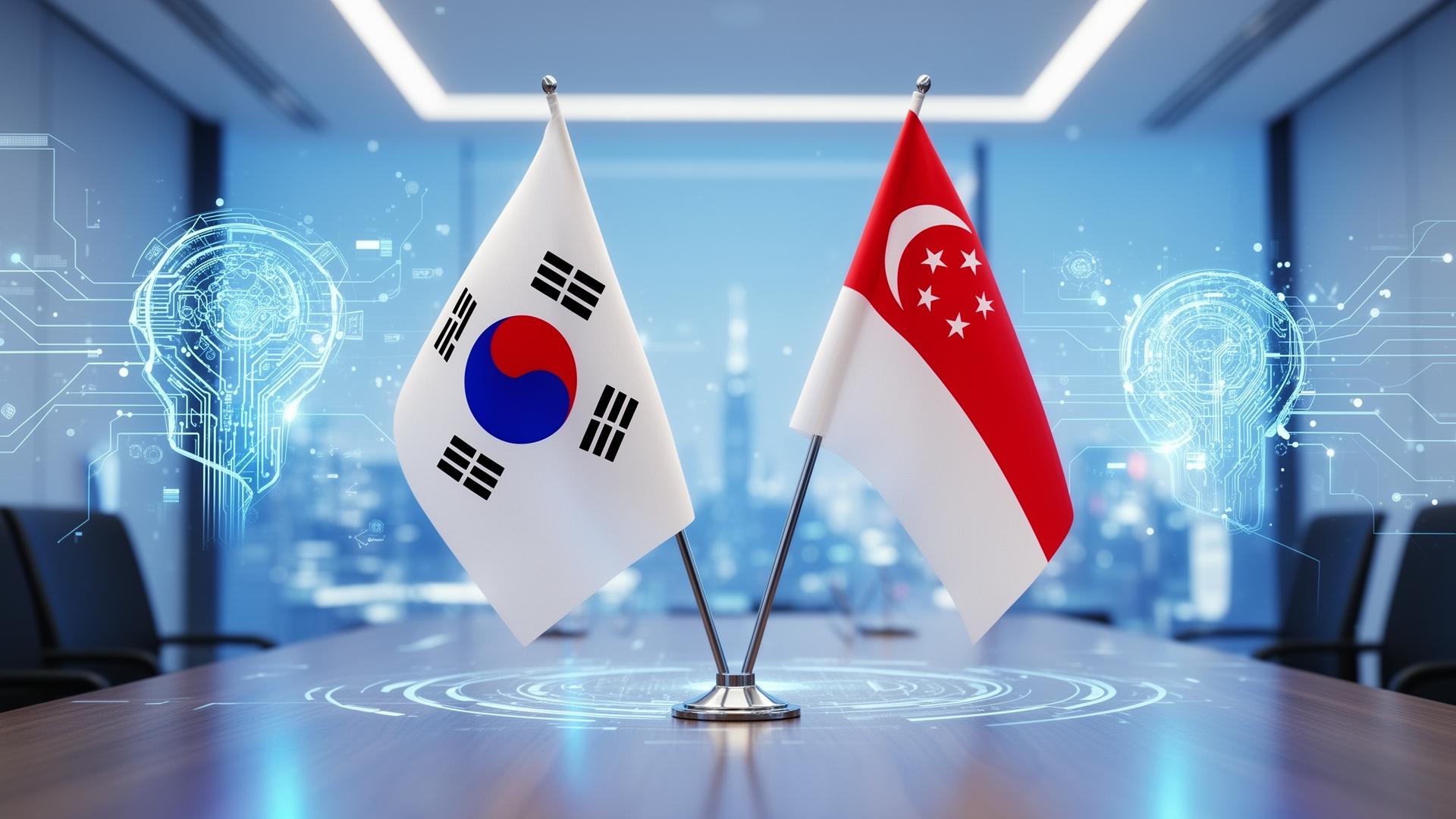
A week-old handshake between Seoul and Singapore now carries a price tag. South Korea and Singapore have formally launched a $300 million AI alliance, anchored by a new global venture fund and five bilateral MOUs covering everything from public safety AI to small modular reactors. The deal, struck during President Lee Jae-myung's state visit to Singapore on 2 March, marks the most ambitious bilateral AI pact in Asia this year.
The alliance is not just about money. It is a calculated bet that two mid-sized economies, by combining complementary strengths, can outpace larger rivals in the race to define how AI is built, governed, and deployed across the region.
What the Alliance Actually Includes
At the centre of the deal is the K-VCC fund, a $300 million government-backed venture vehicle that South Korea's Ministry of SMEs and Startups will establish in Singapore by 2030. The fund, routed through Singapore's financial infrastructure, will target early and growth-stage AI startups in both countries, with a focus on edge computing, physical AI applications, and industrial automation.
Beyond the fund, the two governments signed five MOUs spanning science and technology cooperation, AI and digital technology in public safety, intellectual property frameworks, environmental satellite data sharing, and small modular reactor development. The leaders also agreed to launch formal negotiations to upgrade their 20-year-old free trade agreement, targeting supply chains, green economy provisions, trade facilitation, and aviation MRO services.
BY THE NUMBERS
- $300 million target for the K-VCC global fund by 2030
- 5 MOUs signed across AI, IP, nuclear energy, and satellite cooperation
- 150 entrepreneurs, VCs, and researchers attended the AI Connect Summit
- 20 years since the original Korea-Singapore FTA, now being upgraded
Why These Two Countries, Why Now
The strategic logic is unusually clean. South Korea brings semiconductor manufacturing, data centre infrastructure, and a globally competitive hardware supply chain. Singapore contributes world-leading AI governance frameworks, a deep venture capital ecosystem, and its position as the data hub for Southeast Asia's 700 million consumers.
"Our advantage does not necessarily lie in building the largest or the latest frontier large language models, but in the deployment and adoption of AI extensively, responsibly, effectively and across the entire society." - Dr Vivian Balakrishnan, Minister for Foreign Affairs, Singapore
Dr Balakrishnan, speaking at the Korea-Singapore AI Connect Summit at the Shangri-La Hotel, described the partnership as "a bridge between two innovative ecosystems" and called South Korea "an optimal and ideal partner" for Singapore's AI ambitions. He suggested both countries could collaborate on trusted supply chains and interoperable global standards for AI systems.
The President's AI Ambition
President Lee has been explicit about his goals. He wants South Korea to become one of the world's top three AI powers, and has framed the Singapore partnership as a cornerstone of that strategy. At the summit, Lee argued that bilateral AI cooperation should evolve beyond technology exchanges into a "strategic industrial partnership" to position both nations as "Asia's leading innovation hub."
"AI cooperation should evolve beyond simple technology exchanges into a strategic industrial partnership." - President Lee Jae-myung, Republic of Korea
How This Stacks Up Against Other AI Deals in Asia
The Korea-Singapore alliance enters a crowded field of bilateral AI agreements across the region, but its structure sets it apart in several ways:
- Unlike the Japan-UK Hiroshima AI Process, which focused on governance principles, the Korea-Singapore deal pairs policy alignment with a dedicated investment vehicle.
- The India-US AI partnership announced at the AI Impact Summit in February centres on infrastructure and compute. The Korea-Singapore deal targets startups and applied AI.
- ASEAN's AI governance framework remains voluntary and non-binding. The bilateral MOU approach gives Seoul and Singapore enforceable commitments.
- China's bilateral AI deals in Southeast Asia, including with Thailand and Indonesia, focus primarily on deployment of Chinese models. The Korea-Singapore pact explicitly prioritises interoperability and open standards.
The Asia-Pacific Picture
The deal reflects a broader shift in how Asian governments are approaching AI strategy. Rather than trying to compete head-on with the US and China on foundation models, mid-sized economies are forming targeted alliances to control specific layers of the AI stack.
Taiwan's TSMC dominates advanced chip fabrication. Japan's SoftBank is building compute infrastructure through its ARM holdings. India is positioning itself as the world's AI talent factory. Now Korea and Singapore are staking their claim on applied AI commercialisation and governance standards.
For Southeast Asian startups, the K-VCC fund represents a significant new source of capital. Singapore's existing status as ASEAN's venture hub means the fund will likely attract co-investment from regional LPs, amplifying its impact well beyond the initial $300 million commitment.
What Comes Next
K-VCC FundStructure announced, Singapore HQ confirmedFirst $100M deployed, 15-20 portfolio companies FTA UpgradeNegotiations launchedUpdated agreement covering AI services and data flows AI Safety StandardsJoint working group formedInteroperable AI audit framework for both markets Talent ExchangeMOU signed on S&T cooperationJoint AI research fellowships at KAIST and NUS Physical AICooperation framework agreedPilot projects in smart manufacturing and robotics
Frequently Asked Questions
What is the Korea-Singapore AI Alliance?
It is a bilateral partnership launched on 2 March 2026 during President Lee Jae-myung's state visit to Singapore. The alliance includes a $300 million venture fund, five MOUs on technology cooperation, and a commitment to upgrade the countries' free trade agreement with AI-specific provisions.
How does the $300 million K-VCC fund work?
The fund is being established by South Korea's Ministry of SMEs and Startups with its headquarters in Singapore. It targets AI startups at all growth stages, with a focus on edge computing, physical AI, and industrial applications. The $300 million target is set for completion by 2030.
Why are South Korea and Singapore partnering on AI instead of going it alone?
The two countries have complementary strengths. South Korea leads in semiconductors, hardware manufacturing, and data centre infrastructure, while Singapore excels in AI governance, venture capital, and serves as the data hub for Southeast Asia. Together, they aim to compete more effectively against larger AI powers.
THE AIINASIA VIEW
We have seen plenty of AI partnership announcements that amount to little more than photo opportunities and vague communiques. This one is different. The K-VCC fund gives the Korea-Singapore alliance actual capital to deploy, and the FTA upgrade negotiations attach trade consequences to AI cooperation for the first time in Asia. The real significance is structural: two countries are proving that you do not need to build frontier models to shape the AI economy. You need to control the governance layer and the commercialisation pipeline. If this model works, expect Japan, Australia, and the Gulf states to replicate it within 18 months.
The biggest question hanging over bilateral AI deals in Asia is whether they survive changes in government. President Lee has staked significant political capital on this partnership, and PM Wong has reciprocated. But if the next election cycle in either country shifts priorities, does the K-VCC fund keep deploying, or does it become another dormant vehicle? What would convince you that a government AI partnership is built to last beyond the leaders who signed it? Drop your take in the comments below.
YOUR TAKE
We cover the story. You tell us what it means on the ground.
What did you think?
Share your thoughts
Be the first to share your perspective on this story
This is a developing story
We're tracking this across Asia-Pacific and may update with new developments, follow-ups and regional context.