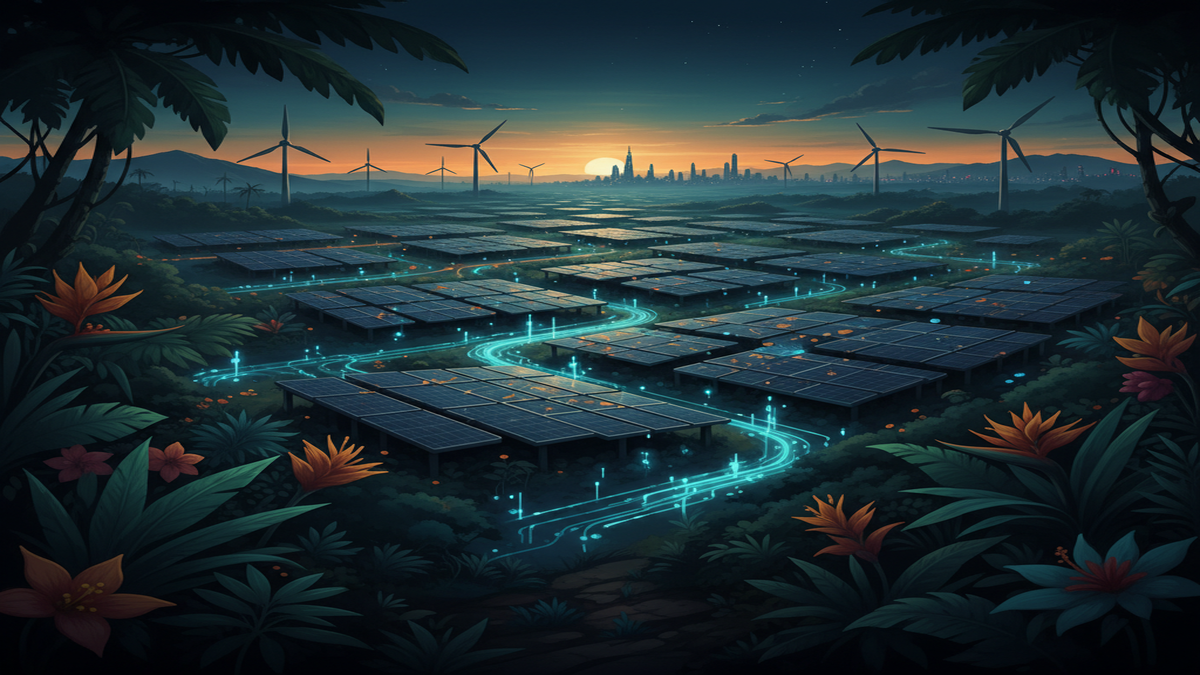
AI Is Powering ASEAN's Trillion-Dollar Clean Energy Bet
"A few years ago, AI was applied only to small parts of projects, but now it is used across the entire value chain. Its growing importance is driving innovation in supply chains and creating exciting opportunities for energy, particularly in Asia."
— Fabricio Sousa, Global President, Worley Consulting & Technology Solutions
Southeast Asia faces a defining energy challenge. Economic growth across ASEAN nations has created soaring electricity demand, yet the region must simultaneously decarbonise and diversify away from coal-heavy generation. Renewable energy capacity is expanding rapidly, but solar and wind are inherently variable. Grid stability depends on accurate forecasting, dynamic resource allocation, and split-second decisions across thousands of interconnected points. This is where artificial intelligence enters the equation, not as a distant possibility but as an operational necessity.
Worley's observation reflects a broader industry shift. Across ASEAN, AI is no longer confined to pilot projects—it is being deployed across entire value chains, from project planning through operational optimisation. Organisations like Worley Consulting & Technology Solutions are leading this transformation, recognising that AI's ability to drive innovation across supply chains and energy systems is unlocking competitive advantage in one of the world's fastest-growing regions.
ASEAN's clean energy infrastructure is being built smarter from the ground up. Drones equipped with AI-powered computer vision are collecting high-resolution aerial data to map solar exposure, analyse wind patterns, and assess land suitability for renewable installations. The same technology monitors construction sites in real time, flagging delays and safety issues before they compound costs. Once facilities are operational, thermal imaging and predictive maintenance algorithms extend asset lifespan and reduce unplanned downtime. These applications are no longer experimental; they are becoming standard practice across the region's energy projects. The infrastructure demands supporting these technologies—from power delivery to cooling systems—are also driving surging demand for AI memory chips and related infrastructure that spans the entire ASEAN region.
The Grid Optimisation Imperative
Traditional power grids were designed for predictable, centralised generation. Renewable energy inverts that model. When the sun sets or wind patterns shift, grid operators must instantly balance supply and demand across networks that now include thousands of distributed solar installations, battery systems, and flexible loads. AI algorithms process real-time data from sensors, weather forecasts, and historical patterns to optimise dispatch, reduce curtailment, and maintain frequency stability. The financial impact is tangible: reduced spinning reserves, lower balancing costs, and fewer emergency load-shedding events. However, achieving reliable AI deployment requires solving the challenge of ensuring enterprise AI pilots actually reaching production at scale—a hurdle many organisations across the region are actively working to overcome.
The AiXEnergy exhibition at Gastech Bangkok in September 2026 will showcase this evolution in real time. Industry players are converging to present AI solutions for grid optimisation, demonstrating how the technology is moving from pilot projects into commercial deployment across the region.
Data Centre Pressures Drive Innovation
Southeast Asia's data centre expansion is both a constraint and a catalyst. Facilities in Singapore, Malaysia, Indonesia, Thailand, and the Philippines are expanding rapidly to support cloud computing, artificial intelligence training, and digital services. However, each facility requires reliable, abundant electricity. Power limits are becoming the limiting factor for growth. This pressure is forcing innovation across three vectors: onsite solar generation, battery storage systems, and compute platform modernisation. AI helps optimise all three simultaneously, identifying when to draw from the grid, when to charge batteries, and when to utilise onsite generation based on real-time pricing, weather forecasts, and workload patterns. The intensity of this competition is reflected in recent developments around surging demand for AI infrastructure across Asia, a trend reshaping how regional data centre operators allocate resources and investments.
Key Applications Transforming the Region
- Solar farm forecasting: AI predicts cloud cover and irradiance 24 to 48 hours ahead, enabling grid operators to prepare balancing resources
- Wind resource assessment: Machine learning models analyse meteorological data to identify high-potential sites and optimise turbine placement
- Battery dispatch optimisation: Algorithms maximise the value of energy storage by timing charge and discharge cycles to exploit price signals and grid conditions
- Load prediction: Demand-side AI forecasts electricity consumption patterns at neighbourhood and district scales, supporting demand response programmes
- Fault detection and prevention: Thermal sensors and computer vision systems detect equipment degradation before failures occur
- Grid stability and frequency control: Real-time AI systems balance supply and demand to maintain grid frequency within operational limits
"Artificial intelligence could reshape how ASEAN power systems manage rising shares of variable renewable energy, with measurable cost and emissions reductions."
— Ember, AI and Renewable Energy in ASEAN Report (2026)
By The Numbers
- US$4 billion: Southeast Asia AI sector valuation in 2024
- 4x growth: Projected expansion by 2033
- 23%: Percentage of ASEAN businesses with full AI adoption
- 90%+: GenAI-savvy firms using AI competitively
- 15%: Expected increase in ASEAN enterprise AI spending in 2026
- 96%: Asia Pacific enterprises planning to increase AI investment in next 12 months
- US$2.2 billion: Microsoft's AI infrastructure commitment to Malaysia
ASEAN Clean Energy AI Adoption by Country
| Country | Key AI Applications | Data Centre Growth | Enterprise AI Adoption Rate |
|---|---|---|---|
| Singapore | Grid optimisation, battery dispatch, smart metering | High (expansion constrained by power limits) | 40%+ |
| Malaysia | Solar forecasting, wind assessment, thermal monitoring | Expanding (Microsoft US$2.2 billion investment) | 25% |
| Indonesia | Drone-based site assessment, construction monitoring, predictive maintenance | Moderate growth | 18% |
| Thailand | Load prediction, demand response, fault detection | Expanding | 22% |
| Philippines | Renewable resource mapping, grid stability, frequency control | Growing | 15% |
Frequently Asked Questions
How does AI improve renewable energy forecasting?
AI models ingest real-time weather data, satellite imagery, historical patterns, and sensor readings to predict solar irradiance and wind speeds hours or days ahead. These forecasts allow grid operators to procure balancing resources in advance, reducing last-minute emergency measures and the cost of maintaining spinning reserves.
What role do drones play in ASEAN's energy projects?
Drones equipped with thermal imaging and computer vision conduct high-resolution aerial surveys to identify optimal locations for solar and wind installations, monitor construction progress, detect equipment failures, and perform maintenance inspections without disrupting operations. This reduces survey costs and accelerates deployment cycles.
How are data centres accelerating clean energy integration?
Data centres have enormous, predictable electricity demands but face power availability constraints in Southeast Asia. Operators are deploying onsite solar and battery systems, then using AI to orchestrate when to draw from the grid, charge batteries, and utilise onsite generation based on prices, weather, and workload. This creates a learning network that benefits the broader grid.
What is the employment outlook for AI specialists in ASEAN energy?
The region faces an acute AI talent shortage, with demand far outpacing the supply of skilled engineers, data scientists, and domain experts. Salaries are rising rapidly, and multinational firms are competing aggressively for local talent. Enterprise spending on AI rose 15 per cent in 2026 and is expected to continue accelerating, widening the skills gap further. Individuals with expertise in energy systems, machine learning, and cloud platforms are among the most sought-after professionals in ASEAN.
Will AI-powered renewables make ASEAN energy independent?
AI cannot eliminate the intermittency of renewable energy entirely, but it can dramatically reduce its cost and complexity. Long-duration battery storage, interconnected regional grids, and flexible demand-side management all complement AI forecasting and optimisation. The combined effect moves ASEAN towards much higher renewable penetration and energy security, though some dispatchable capacity (whether fossil, nuclear, or hydro) will likely remain part of the mix for many years.
The Path Ahead
ASEAN's clean energy transition is already underway. What artificial intelligence adds is precision, speed, and scalability. An Ember report analysis underscores that AI could unlock the next wave of renewable integration across the region by making variable renewables economically and technically viable at unprecedented scales. The investments are flowing: Microsoft, global energy consultancies, and domestic enterprises are all placing bets on AI-powered infrastructure. The grid operators, renewable developers, and data centre operators driving these decisions are not experimenting; they are responding to genuine operational imperatives and competitive pressures. Within five to ten years, ASEAN grids operating without AI-powered optimisation will appear as quaint as power plants without automation do today.
The trillion-dollar clean energy bet is not a distant aspiration. It is happening now, powered by algorithms that can manage complexity humans cannot. Whether you are an energy professional, a technology investor, or a policy maker shaping ASEAN's industrial future, the convergence of artificial intelligence and renewable energy is reshaping the region's economic prospects. The question is not whether AI will play a role in ASEAN's energy transition. It is whether your organisation is prepared to compete in a world where it already does. Drop your take in the comments below.