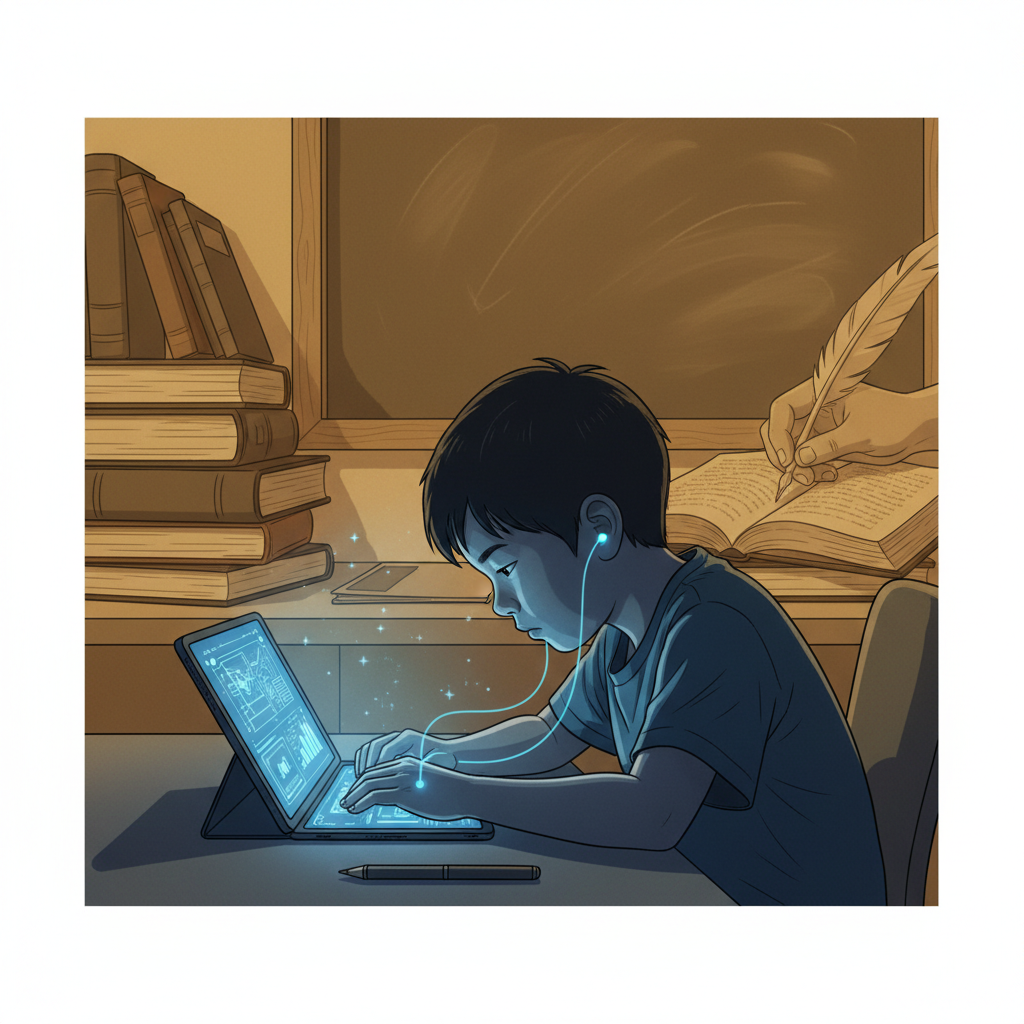
Across East and Southeast Asia, a quiet revolution is unfolding in children's bedrooms. AI tutors are replacing hagwon teachers, chatbots are answering homework questions at midnight, and parents are celebrating improved test scores without asking what is being lost in the trade. As someone who has watched this region's relationship with educational technology evolve for years, I believe we are sleepwalking into a generational experiment with consequences we barely understand.
The thesis is uncomfortable but necessary: Asia's embrace of AI tutoring, fuelled by a culture that prizes academic achievement above almost everything else, risks producing a generation of high-scoring children who struggle to think independently. The data is starting to back this up, and parents across the region need to hear it before the pattern becomes permanent.
The Hagwon Gets an Upgrade
Asia has always been the world's most enthusiastic adopter of supplementary education. In South Korea, approximately 75 per cent of children attend hagwons (private cram schools), a figure that has barely shifted in two decades. Japan's juku system enrols more than 65 per cent of ninth graders. China's vast tutoring industry, despite a regulatory crackdown in 2021, has simply migrated online and, increasingly, into AI.
The difference now is speed and scale. South Korea has embedded AI coursework into its national curriculum across all grade levels and rolled out personalised AI tutors that adapt to each student's "tendencies and learning behaviours." Hong Kong's Education Bureau has made AI literacy and digital ethics core components of its primary curriculum under a new Digital Education Blueprint. India, where Microsoft is training two million teachers in AI, is racing to integrate the technology from the ground up.
For parents in high-pressure education systems, AI tutors feel like the answer to an impossible equation: more academic support, available around the clock, at a fraction of the cost of a human tutor. Global student AI usage has leapt from 66 per cent in 2024 to 92 per cent in 2025, according to recent education surveys. In the Asia-Pacific region, that number skews even higher, driven by cultural attitudes that frame AI not as a risk but as a legitimate strategy for educational advantage.
"In East Asian contexts such as South Korea and China, AI is often welcomed as a tool to enhance academic competitiveness, with state-endorsed AI tutoring initiatives aligning with parental aspirations for accelerated learning." — Frontiers in Education, 2026
When the Tutor Becomes a Crutch
Here is where the narrative breaks down. A growing body of research, much of it published in just the last twelve months, suggests that AI tutoring may be improving scores while quietly undermining the cognitive skills that matter most.
In a large randomised trial studying secondary mathematics students, those using GPT-based tutors performed worse on follow-up examinations when the AI was removed. They showed no long-term learning gains and, perhaps most troublingly, "substantially overestimated their preparedness." They thought they understood the material. They did not.
Harvard Graduate School of Education researcher Ying Xu has raised pointed concerns about AI "outsourcing" independent thinking and critical problem-solving. Her work, focused on AI technologies for children and families, highlights a pattern: younger users (ages 17 to 25) show higher dependence on AI tools and lower thinking scores than older groups. The implication is stark: the earlier children adopt AI as a learning partner, the greater the risk to their intellectual autonomy.
A January 2026 Brookings Institution report echoed these findings, concluding that while AI "can expand access to learning and personalise instruction," those benefits are "currently overshadowed by risks ranging from privacy and safety concerns to diminished critical thinking and overreliance on automation."
This is not an abstract Western concern. It lands squarely in Asia, where AI language tutors are already replacing classrooms and where the cultural pressure to adopt any tool that boosts grades is immense. When generic AI chatbots are failing in classrooms, the solution is rarely to slow down; it is to find a better chatbot.
The Emotional Cost Nobody Talks About
The cognitive risks are only half the story. Research published in 2025 and 2026 identifies three primary domains of harm from AI dependency in children: psychological wellbeing (emotional disconnection and social isolation), intellectual agency (reduced independent learning and weakened creative ownership), and what researchers describe as "digital attachment disorder."
AI companions, including those marketed as educational tools, can "exploit emotional vulnerabilities through unconditional regard, triggering dependencies while hindering social skill development." In a region where millions are already paying for AI friends and where therapy apps are stepping into cultural silence around mental health, children represent the most vulnerable population of all.
The American Academy of Pediatrics recognised this in January 2026 when it overhauled its screen time guidelines for the first time in a decade. The new framework, titled "Digital Ecosystems, Children, and Adolescents," abandons rigid time limits in favour of assessing quality, context, and family connection. A child having an engaging, educational conversation with a well-designed AI tool is fundamentally different from a child scrolling social media; the AAP now acknowledges this distinction.
But the guidelines also carry an implicit warning: the digital ecosystem surrounding children is not a single screen. It is a web of platforms, apps, games, and AI tools that interact with each other and with the child in ways parents rarely see.
By The Numbers
- 92% of students globally used AI in their learning in 2025, up from 66% the year before (DemandSage, 2026)
- 75% of South Korean children attend hagwons; AI tutoring is now integrated into the national curriculum
- 76% of education leaders say AI literacy is essential to a basic education, but only 54% of teachers agree (Engageli, 2026)
- 30% learning outcome boost reported from AI tutoring systems, yet long-term retention gains remain unproven
- 24.7% CAGR for Asia-Pacific AI education market through 2035, the fastest-growing region globally
Scout View
The core argument: Asia's deep cultural investment in academic achievement has made it the world's fastest adopter of AI tutoring tools, but emerging research shows these tools can undermine the very skills they promise to develop: independent thinking, long-term retention, and emotional resilience. Parents, schools, and policymakers across the region urgently need guardrails that prioritise learning over scores.
What to watch: South Korea's national AI curriculum rollout, Hong Kong's Digital Education Blueprint implementation, and the Brookings Institution's ongoing monitoring of AI in education will be the key signals of whether Asia course-corrects or doubles down.
FAQ
Isn't AI tutoring better than no tutoring at all?
For children who lack access to quality teachers, particularly in rural areas of India, Indonesia, and the Philippines, AI tutoring can be a genuine lifeline. The concern is not with AI as a supplement but with AI as a replacement for human-guided critical thinking. The best outcomes in research come from blended approaches where AI handles repetitive practice and a human teacher guides reasoning and discussion.
My child's grades have improved since using AI tools. Should I be worried?
Improved grades are not the same as improved learning. The randomised trial on GPT-based tutors found that students scored well with AI support but performed worse without it. Ask whether your child can explain their reasoning without the tool. If they cannot, the AI may be doing the thinking for them.
What are Asian governments doing about this?
Responses vary widely. South Korea is integrating AI into its curriculum with personalised tutors for every student. Hong Kong is embedding digital literacy and AI ethics into primary education. China continues to regulate the tutoring industry while promoting state-backed AI platforms. India is focusing on teacher training. No country in the region has yet implemented comprehensive child-specific AI safety standards, though ASEAN's shift from guidelines to binding rules may accelerate this.
At what age should children start using AI tools?
The AAP's 2026 guidelines deliberately avoid setting a specific age threshold, focusing instead on whether the tool is interactive, age-appropriate, and used alongside a parent or teacher. For younger children, real-world play and unstructured exploration remain essential. AI tools designed specifically for children, with guardrails and educational intent, are a different proposition from giving a child unrestricted access to a general-purpose chatbot.
Closing Thoughts
I do not believe AI tutoring is inherently harmful. What concerns me is the speed at which Asia is adopting these tools without pausing to ask what happens when the tutor is switched off. The region's cultural reverence for education is a strength, but it becomes a vulnerability when it drives uncritical adoption of any technology that promises better scores.
Parents across Asia face a choice that previous generations never had to make: how much of their child's intellectual development to delegate to a machine. The answer does not have to be zero. But it should not be "everything, as long as the grades go up."
The children growing up with AI tutors today will enter a workforce that demands creativity, adaptability, and independent judgement: precisely the skills that over-reliance on AI may erode. The smartest investment Asian parents can make in 2026 is not another AI subscription. It is the time spent asking their child, "What do you think?"