A novel supply chain waddles underground
Shenzhen’s Line 2 — among the busiest in the city — is now shared with 41 autonomous delivery bots operated by VX Logistics, a Vanke-owned arm partly held by Shenzhen Metro .
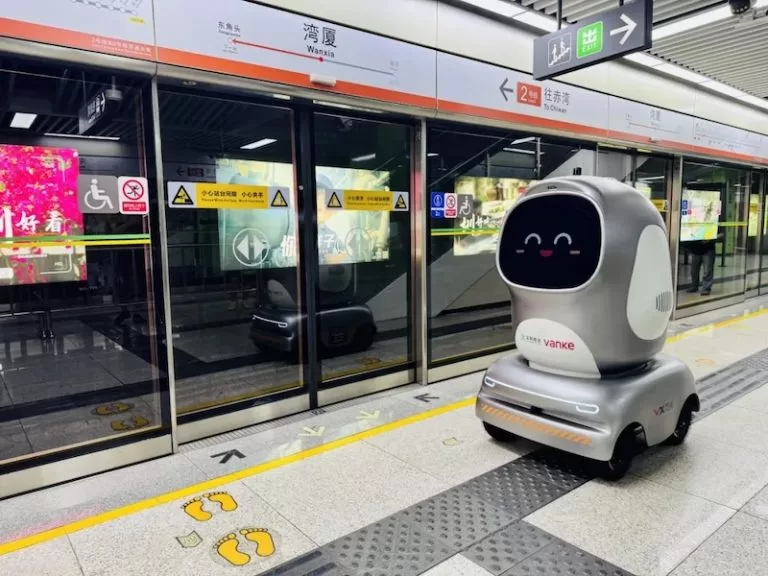
Shenzhen’s Line 2 — among the busiest in the city — is now shared with 41 autonomous delivery bots.,These penguin‑like robots, dodge platform gaps, navigate elevators, and board carriages during off‑peak hours.
These penguin‑like robots, complete with LED ‘faces’, navigate platform gaps, elevators, crowds and board carriages during off‑peak hours, and deliver directly to 7‑Eleven stores spread across more than 100 station outlets .
Equipped with panoramic LiDAR and AI routing systems, they make real‑time decisions based on order volume, train schedules, store location, and footfall . As Hou Shangjie, VX’s head of automation, put it:
“They are specially designed with unique chassis systems that allow them to cross gaps to enter lifts and carriages…They will continue to iterate based on real‑world performance”
“They are specially designed with unique chassis systems that allow them to cross gaps to enter lifts and carriages…They will continue to iterate based on real‑world performance”
Solving the underground logistics puzzle
For station-based convenience retailers, delivering goods used to require street-level carts lugged through busy entrances — a time-consuming, peak-hour challenge. Li Yanyan, manager at a participating 7‑Eleven, explained: “In the past, delivery workers had to park above ground, unload goods, and manually push them into subway stations. Now, with robots, it’s much easier and more convenient”
The bots presently operate outside rush hours, tapping into unused capacity in trains to reduce surface traffic, lower labour overhead and speed deliveries . Distributing around 41 bots suffices to meet peak restock demands for all participating stores, particularly in a system that ferries around nine million passengers daily.
Robotics meets smart‑city ambition
This pilot links with Shenzhen’s “Embodied Intelligent Robot Action Plan” unveiled in March, which targets widespread deployment of service and industrial robots by 2027 . With over 1,600 robotics firms, the city is positioned as a public‑space automation testbed.
National policy also encourages robots in roles from eldercare to hazardous‑environment inspection — blending human labour with mechanised efficiency . For VX Logistics, this is a stepping‑stone to creating a “flexible delivery artery” that extends across metro networks, linking upriver transport modes with automated subsurface logistics.
Next stops: parcels, pharmacy, patient care?
If the trial succeeds, the model could scale beyond snacks to parcels, cleaning supplies — even medical deliveries. Its significance lies in pioneering automation not just at street level, but mid‑route via public transit.
As Li Yanyan observed, tasks once tedious for humans have now become “a routine hop on and off the train” .
As Li Yanyan observed, tasks once tedious for humans have now become “a routine hop on and off the train” .
Foreign observers have noted that this system signals a broader shift — from robots in factories to assistants in everyday life . Soon, commuters in other cities might also share their ride with these fetching, friendly machines.
What it all means
Urban efficiency: The project eases surface‑traffic congestion, optimises underground spaces and trims delivery costs.,Automation in action: Shenzhen showcases a fully integrated, multimodal logistics network that merges AI, infrastructure and public services. Scalability tested: Future iterations may carry mixed parcels and connect with freight systems — framing metro lines as logistical arteries, not just passenger routes.
As robotic supply chains glide through underground rails, we edge closer to a future where public transport is as much a delivery network as a commuting network. Would you feel comfortable sharing your train with a bot that's restocking your local store?
YOUR TAKE
We cover the story. You tell us what it means on the ground.
What did you think?
Related Articles
View more
Singapore Lands a $3.9 Billion AI Data Centre Bet
A Bain Capital-backed firm plans to pour billions into AI-ready infrastructure, positioning Singapore as Asia's compute capital.
5 min read

3 Before 9: March 16, 2026
3 must-know AI stories before your 9am coffee. The signals that matter, delivered daily.
3 min read
Hong Kong Backs New AI Research Institute With Billions
A city built on finance is now building institutions for AI, and the IPO pipeline suggests the money agrees.
6 min read
Share your thoughts
Be the first to share your perspective on this story
This is a developing story
We're tracking this across Asia-Pacific and may update with new developments, follow-ups and regional context.